A collection of short spurts of thought which result in the funny, thought-provoking, poignant worldview of a Madam who lives in Pune, India - the Oxford of the East, the Home of the Shrewsbury Biscuit, and the road-accident fatality-and-brain-damage capital of the world.
Sunday, October 9, 2011
Monday, September 5, 2011
You can always find something to laugh about
One of my enduring memories of my father’s illness is of his morning walk. Glancing out of my kitchen window, I would see him shuffling along with an attendant’s support, and my heart would contract. He had been a tea planter, walking ten miles effortlessly in the course of a day. To see him reduced to a doddering, inarticulate wreck decades in advance of his time was not something I ever got used to.
In another haunting memory, my son, then ten or eleven, newly enamoured of the daily newspaper, runs toward me excitedly waving a headline and shouting, “Look, Mumma! New cure for Parkinson’s!” I would sigh and hug him.
We had learnt long before that Parkinson’s does not have a miracle cure. It is a cruel, unpredictable disease that manifests in symptoms as unique to victims as their fingerprints. Tremor, rigidity, and slowness come in varying degrees, compounded by other symptoms.
My father endured long bouts of acupuncture, then Ayurveda, to no effect. ‘Stereotactic’ surgery gave him temporary parallel vision. One eye flopped over. A photograph of him with an eye patch at my cousin’s wedding serves as a permanent reminder to apply caution in the matter of proselytising doctors.
In 2001, I watched in silence as a colleague was seduced by one of those newspaper headlines. He borrowed Rs3 lakh for an operation to cure his father, determined that he wouldn’t suffer what his Parkinsonian uncle and aunt had: falls, broken bones, agonies while bedridden, and premature death. Tissue was implanted. In three months he succumbed to multiple infections and went from bed straight to crematorium. The headline hadn’t clarified that a patient on immunosuppressants would require a sterile environment.
But my dad was surrounded by knowledge and care. One of the first things he did was subscribe to the Parkinson’s Disease Society newsletter. While publishing research results cautiously, it offers advice on coping with dignity while adapting to the clumsy stranger gradually invading your body. His diet, medication, and physiotherapy was monitored by his most devoted attendant, my mother. She was no-nonsense Matron, setting impossibly high quality standards for the ones we hired. She made sure he ate all that we did – as he grew older and his teeth gave way, she would grind each delicacy separately. And my dad knew how to minimise damage when he fell, a poignant reminder of his days as a sportsman. So in twenty-six years, he broke only one bone.
When he lay in hospital, adapting to a synthetic-blended femur ball, my brother and I, our spouses and children, visited, gushing with affection and little treats, to which he responded well, being a man who was easy to please. Fifteen years into the disease, conversation was a chore. By the time he worked up a few words, the other person would have given up. We tried our best, but it was a protracted process.
He passed the time playing chess. To move a piece he’d recruit his opponent’s help, relaying instructions through cryptic signals of eye and head. One day, as a lovely young physiotherapist manipulated his limbs and led him through breathing exercises, another young woman in a white coat peered around the door, scolding: “That’s my patient!”
His face expressionless (another symptom of Parkinson’s), he mouthed, in hoarse, gravelly tones: “Turf wars!”
I guffawed aloud, delighted as much with the joke as with his still-vibrant sense of humour. They turned wary, uncomprehending eyes on me.
Sadly, the stretch in hospital was followed by bed sores, and took months to heal. My mother dusted antiseptic powder and made sure he was turned every half hour. We watched helplessly when he groaned in pain, and she alternated kind caresses with stern orders to behave.
Nursing help, a fledgling industry, presents ludicrous schisms between front-office sales and back-office service. Promising angels of mercy, the bureaus in my city dispatched louts off the street who slouched and scratched their bottoms. They arrived, if at all, long after the night-shift helper – an angel of mercy, a woman – had left. One man arrived just in time to help me through a toilet crisis. He shook his head, muttering repeatedly, “Oh my god, what a nuisance!” and luckily slipped away, without notice, before I slapped him. Even those with hospital experience would collect a tidy lumpsum after a few days and stay home to booze it up. Nilesh, gentle and proficient, lasted a good stretch until one day he tootled off on the mali’s bicycle and never came back. The bureaus are still calling, a year after I don’t need them any more.
My father had been diagnosed at fifty. He was seventy-six when he died last year. We sat with the body, reflecting. He had suffered so much in the last few months that I felt glazed with relief. Only later would I mourn the loss of someone who could feel my pain; whose quiet courage had given me the strength to face the challenges of my own life. There’s no tonic more motivating than a father’s pride, even when the silent glow is barely perceptible behind an impassive, Parkinsonian face. I said, “D’you think he’d have liked us to have an Irish wake?” “What’s that?” asked my daughter. “No idea,” I replied, “I think they stay up all night drinking and dancing.” “Oh,” she said, deadpan, “I thought that was called Friday night.”
It was his genius for spotting the comic heart of a situation that had taught us to take our troubles lightly. We turned to him, anticipating the characteristic half-smile, but he lay still and unresponsive. The current Economist, subscription a thoughtful gift from my brother, remained unopened.
When I was little, my father gave me stylish haircuts and the other plantation wives begged him to do the same for their daughters. “Can’t smack them if they fidget,” he explained, by way of polite refusal. My brother wept copiously when he told us about Oliver Twist, Sohrab and Rustom and others – while I reached for another cutlet, thinking, “Life is tough, get used to it, er, Portia.” He had a tuneful singing voice his grandchildren would never hear. We lived in the house on the hill, and he was lord of all we surveyed. Years later when I visited with my kids, enthusiastically pointing out my old carved rosewood cupboard and an iron stove just like the one we’d seen in the kitchen of Henry VIII’s Hampton Court, people remembered him as the one who rode through the fields with our dog balancing coolly on pillion.
If we ever saw a quivering, dribbling, old man my father would shudder and say, “Poor fellow! I hope I never get that way.” In later years we never pre-empted disease; never made flippant statements about health.
By saying, expansively, “You can be anything you want,” he gave me freedom of choice, appreciation of competence – and permission for situational nonconformity. At boarding school, I once received a letter containing something he’d liked and typed out, with a note saying I should read and pass it on to my brother: “Ten lessons for my sons”. I suppose it was this, compounded by my brother’s unremitting generosity, which had me performing his cremation rites.
As we grew older, and he became more disabled and dependent, he became our role model of dignity and gracious acceptance. We learnt from him that it was possible to be a responsible person and participate in the joy of living even within the narrowest parameters. As his ability to communicate reduced, we learnt that silent dignity carries its own message. Those around him, many who had never known him as we had, full of humour, kindness and vitality – even strangers – continued to respond to him with the same quality of affection and regard that he had always drawn.
My father left me with a room of my own: a position from which, as Virginia Woolf eloquently observed, one’s publishers’ political affiliations are of little consequence. Embroiled recently in a compromising hospital procedure, I drew courage from the memory of his stoic bravery when faced repeatedly with worse. It struck me that his real legacy was the comprehension that disability cannot prevent anyone from living life to the full, with good humour, wit, and dignity.
Parts of this first appeared as ‘Living with Parkinson’s’ in Open magazine on 5 Sep 2011
In another haunting memory, my son, then ten or eleven, newly enamoured of the daily newspaper, runs toward me excitedly waving a headline and shouting, “Look, Mumma! New cure for Parkinson’s!” I would sigh and hug him.
We had learnt long before that Parkinson’s does not have a miracle cure. It is a cruel, unpredictable disease that manifests in symptoms as unique to victims as their fingerprints. Tremor, rigidity, and slowness come in varying degrees, compounded by other symptoms.
My father endured long bouts of acupuncture, then Ayurveda, to no effect. ‘Stereotactic’ surgery gave him temporary parallel vision. One eye flopped over. A photograph of him with an eye patch at my cousin’s wedding serves as a permanent reminder to apply caution in the matter of proselytising doctors.
In 2001, I watched in silence as a colleague was seduced by one of those newspaper headlines. He borrowed Rs3 lakh for an operation to cure his father, determined that he wouldn’t suffer what his Parkinsonian uncle and aunt had: falls, broken bones, agonies while bedridden, and premature death. Tissue was implanted. In three months he succumbed to multiple infections and went from bed straight to crematorium. The headline hadn’t clarified that a patient on immunosuppressants would require a sterile environment.
But my dad was surrounded by knowledge and care. One of the first things he did was subscribe to the Parkinson’s Disease Society newsletter. While publishing research results cautiously, it offers advice on coping with dignity while adapting to the clumsy stranger gradually invading your body. His diet, medication, and physiotherapy was monitored by his most devoted attendant, my mother. She was no-nonsense Matron, setting impossibly high quality standards for the ones we hired. She made sure he ate all that we did – as he grew older and his teeth gave way, she would grind each delicacy separately. And my dad knew how to minimise damage when he fell, a poignant reminder of his days as a sportsman. So in twenty-six years, he broke only one bone.
When he lay in hospital, adapting to a synthetic-blended femur ball, my brother and I, our spouses and children, visited, gushing with affection and little treats, to which he responded well, being a man who was easy to please. Fifteen years into the disease, conversation was a chore. By the time he worked up a few words, the other person would have given up. We tried our best, but it was a protracted process.
He passed the time playing chess. To move a piece he’d recruit his opponent’s help, relaying instructions through cryptic signals of eye and head. One day, as a lovely young physiotherapist manipulated his limbs and led him through breathing exercises, another young woman in a white coat peered around the door, scolding: “That’s my patient!”
His face expressionless (another symptom of Parkinson’s), he mouthed, in hoarse, gravelly tones: “Turf wars!”
I guffawed aloud, delighted as much with the joke as with his still-vibrant sense of humour. They turned wary, uncomprehending eyes on me.
Sadly, the stretch in hospital was followed by bed sores, and took months to heal. My mother dusted antiseptic powder and made sure he was turned every half hour. We watched helplessly when he groaned in pain, and she alternated kind caresses with stern orders to behave.
Nursing help, a fledgling industry, presents ludicrous schisms between front-office sales and back-office service. Promising angels of mercy, the bureaus in my city dispatched louts off the street who slouched and scratched their bottoms. They arrived, if at all, long after the night-shift helper – an angel of mercy, a woman – had left. One man arrived just in time to help me through a toilet crisis. He shook his head, muttering repeatedly, “Oh my god, what a nuisance!” and luckily slipped away, without notice, before I slapped him. Even those with hospital experience would collect a tidy lumpsum after a few days and stay home to booze it up. Nilesh, gentle and proficient, lasted a good stretch until one day he tootled off on the mali’s bicycle and never came back. The bureaus are still calling, a year after I don’t need them any more.
My father had been diagnosed at fifty. He was seventy-six when he died last year. We sat with the body, reflecting. He had suffered so much in the last few months that I felt glazed with relief. Only later would I mourn the loss of someone who could feel my pain; whose quiet courage had given me the strength to face the challenges of my own life. There’s no tonic more motivating than a father’s pride, even when the silent glow is barely perceptible behind an impassive, Parkinsonian face. I said, “D’you think he’d have liked us to have an Irish wake?” “What’s that?” asked my daughter. “No idea,” I replied, “I think they stay up all night drinking and dancing.” “Oh,” she said, deadpan, “I thought that was called Friday night.”
It was his genius for spotting the comic heart of a situation that had taught us to take our troubles lightly. We turned to him, anticipating the characteristic half-smile, but he lay still and unresponsive. The current Economist, subscription a thoughtful gift from my brother, remained unopened.
When I was little, my father gave me stylish haircuts and the other plantation wives begged him to do the same for their daughters. “Can’t smack them if they fidget,” he explained, by way of polite refusal. My brother wept copiously when he told us about Oliver Twist, Sohrab and Rustom and others – while I reached for another cutlet, thinking, “Life is tough, get used to it, er, Portia.” He had a tuneful singing voice his grandchildren would never hear. We lived in the house on the hill, and he was lord of all we surveyed. Years later when I visited with my kids, enthusiastically pointing out my old carved rosewood cupboard and an iron stove just like the one we’d seen in the kitchen of Henry VIII’s Hampton Court, people remembered him as the one who rode through the fields with our dog balancing coolly on pillion.
If we ever saw a quivering, dribbling, old man my father would shudder and say, “Poor fellow! I hope I never get that way.” In later years we never pre-empted disease; never made flippant statements about health.
By saying, expansively, “You can be anything you want,” he gave me freedom of choice, appreciation of competence – and permission for situational nonconformity. At boarding school, I once received a letter containing something he’d liked and typed out, with a note saying I should read and pass it on to my brother: “Ten lessons for my sons”. I suppose it was this, compounded by my brother’s unremitting generosity, which had me performing his cremation rites.
As we grew older, and he became more disabled and dependent, he became our role model of dignity and gracious acceptance. We learnt from him that it was possible to be a responsible person and participate in the joy of living even within the narrowest parameters. As his ability to communicate reduced, we learnt that silent dignity carries its own message. Those around him, many who had never known him as we had, full of humour, kindness and vitality – even strangers – continued to respond to him with the same quality of affection and regard that he had always drawn.My father left me with a room of my own: a position from which, as Virginia Woolf eloquently observed, one’s publishers’ political affiliations are of little consequence. Embroiled recently in a compromising hospital procedure, I drew courage from the memory of his stoic bravery when faced repeatedly with worse. It struck me that his real legacy was the comprehension that disability cannot prevent anyone from living life to the full, with good humour, wit, and dignity.
Parts of this first appeared as ‘Living with Parkinson’s’ in Open magazine on 5 Sep 2011
Friday, January 14, 2011
A Madam's Life
Once upon a time I fancied myself an intellectual, and put on airs and pretended, like so many others of my generation, to read Sartre, Joyce and others which today’s under-thirties would disdainfully dismiss as ‘books’. Then one day I noticed that weeks had slipped into months and years and all I’d done, day after day, was iron three even-sized but gradually expanding sets of school uniforms (and pajamas, and play clothes) fill three water bottles (and snack boxes, and lunch dabbas). Life blurred into a haze of endless bottles of white shoe polish, unit tests, twice-a-week home-baked chocolate cakes, lazy Saturday afternoon ice lollies and Disney movies, with nothing but some intermittent mommy violence to break the monotony.
It struck me that I might easily lay claim to the title of The Erma Bombeck of Pune. After all, we live in a city of pompous epithets – the self-important Oxford of the East that generates hordes of postgraduates who cannot distinguish an apostrophe from a garden spade.
A phase of adventure tourism began and life became a confusion of grave responsibilities and impossible commitments, with stress-induced ailments resulting in major surgery. Meanwhile, grouchy bad temper had submitted to a sanctimonious streak and I’d become a Reiki Master.
Shouldn’t that be Reiki ‘Mistress’? my friend Amita frowned. But for various reasons I wasn’t that keen to be called a mistress – though now that I think about it, I’ve been called ‘Madam’ for long enough with great forbearance. People recognize me at forty paces – even on the telephone if you want to know the awful truth – as ‘Madam’, and I’ve learnt to live with it and keep smiling. We’re a tiny and sadly marginalized community, us Madams, with our headaches and bridge mornings and afternoon naps, especially these days with attrition figures in the household-help industry marching ahead of the IT and even BPO sectors. Speaking on behalf of the Society of Highly Opinionated and Amply-endowed Madams (SHOAM), Maharashtra chapter, I encourage the government to set aside some kind of reservations for us too. In fact, if I was Chief Minister (and believe me, you could do worse) I would go right ahead and allot separate parking spaces for Madams whose drivers didn’t turn up for work that morning.
As CM, it would also be my pleasant duty to publicize the sensational, path-breaking research of an internationally reputed agency which intimately relates poor driving manners to sexual dysfunction. Men who broke through traffic lights were shown to suffer premature ejaculation. Road hogs who swerved, cut lanes, and shoved small fry out of the way were observed to have the most hilariously teeny-meeny wedding tackle. Those who used the cell phone while driving, the report elaborates, had been blatantly cuckolded many times over. And those who senselessly blared their horns were, naturally, those who leapt onto their beds with hope and anticipation but never managed to actually get horny.
Parts of this appeared in Saaz ki Awaaz under the title Sallying Forth in Times of India, Pune on 13 Jan 2011
It struck me that I might easily lay claim to the title of The Erma Bombeck of Pune. After all, we live in a city of pompous epithets – the self-important Oxford of the East that generates hordes of postgraduates who cannot distinguish an apostrophe from a garden spade.
A phase of adventure tourism began and life became a confusion of grave responsibilities and impossible commitments, with stress-induced ailments resulting in major surgery. Meanwhile, grouchy bad temper had submitted to a sanctimonious streak and I’d become a Reiki Master.
Shouldn’t that be Reiki ‘Mistress’? my friend Amita frowned. But for various reasons I wasn’t that keen to be called a mistress – though now that I think about it, I’ve been called ‘Madam’ for long enough with great forbearance. People recognize me at forty paces – even on the telephone if you want to know the awful truth – as ‘Madam’, and I’ve learnt to live with it and keep smiling. We’re a tiny and sadly marginalized community, us Madams, with our headaches and bridge mornings and afternoon naps, especially these days with attrition figures in the household-help industry marching ahead of the IT and even BPO sectors. Speaking on behalf of the Society of Highly Opinionated and Amply-endowed Madams (SHOAM), Maharashtra chapter, I encourage the government to set aside some kind of reservations for us too. In fact, if I was Chief Minister (and believe me, you could do worse) I would go right ahead and allot separate parking spaces for Madams whose drivers didn’t turn up for work that morning.
As CM, it would also be my pleasant duty to publicize the sensational, path-breaking research of an internationally reputed agency which intimately relates poor driving manners to sexual dysfunction. Men who broke through traffic lights were shown to suffer premature ejaculation. Road hogs who swerved, cut lanes, and shoved small fry out of the way were observed to have the most hilariously teeny-meeny wedding tackle. Those who used the cell phone while driving, the report elaborates, had been blatantly cuckolded many times over. And those who senselessly blared their horns were, naturally, those who leapt onto their beds with hope and anticipation but never managed to actually get horny.
Parts of this appeared in Saaz ki Awaaz under the title Sallying Forth in Times of India, Pune on 13 Jan 2011
Saturday, July 10, 2010
Tools, mining, materials – and fika
In August 2008, Sandvik Asia commissioned me to write a corporate biography, a wonderful assignment that kept me warm and well-fed right through the nasty recession that waited considerately till the project was well on its way.
Theirs is a fascinating story. In 1950, the newly-formed Indian government headed by Jawaharlal Nehru was faced with the task of building a nascent nation. Reeling from the after-effects of the Second World War, the withdrawal of the British, and the terrible tragedies of Partition, a large majority of our country continued to live in abject poverty. But the new government of India had great ambitions. While making plans to develop the villages and helping the farmers to prosper, they laid the base to build an industrial nation.
India had no technology and needed partners. Whom could we turn to? The British had left after a long struggle; German technology had been used for inhuman purposes during the war; The USA was too far away. Finally, it was decided to approach another quiet, inconspicuous country which just happened to have its industrial base intact. Nehru began sending trade delegations to Sweden.
Swedish companies, conservative, long-term planners, hesitated to invest in a country on the other side of the globe where tigers and snakes apparently roamed free on the streets, and the average person might hope to live just thirty-two years. So Nehru went along himself, and charmed their reservations away. In 1960, the swashbuckling Lars de Jounge arrived in Poona (as it was called then), Sandvik Asia’s first Managing Director.
Lars, now eighty-two, lives in the USA and came to Pune and spent some days talking to me about his experiences setting up the factory and starting business in India. He also gave me his wonderful collection of photographs, and many were used in the book. Other former Managing Directors of the company were also extremely helpful, providing any number of interesting stories, and continuous support as the manuscript progressed. E Gunnar Svensson took the trouble to scan and send me every internal news bulletin from his four-year tenure. He even did a thorough proofread of the manuscript, spotting any number of howlers before we went into production.
My most important oral source for this book was Dr Sanjay Basu, a former IIT professor who led Sandvik Asia’s research and development efforts for decades and, now retired, continues as consultant to the company. He showed me around the factories any number of times, explaining processes and answering questions patiently.
Sadly, the company had preserved almost no documents from which we could piece together its history. Luckily there was a solution – and one which turned out to be a fulfilling adventure. We visited the parent company’s archives, preserved in the municipality at Sandviken.
I had been told, “If they want to reward you, they send you to Sweden in July. If it’s a punishment, you get to go in winter.” So when I was told to block dates in November, I knew what that meant and humbly got out my winter coat, gloves and woollen cap, and a whole lot of regular stuff that could be worn in layers for that extra warmth.
We flew to Stockholm via Munich. I was busy soaking in atmosphere from my Stieg Larsson book but couldn’t help notice the cabin crew trying to speak to my neighbour in their plastic-cheerful German. He, being Danish, would stare back, slit-eyed, and sneer disdainfully, “Sorry?” An investment bank had sent him to India and he had been mighty impressed with the progress in the nation but I think he changed his mind when I said I was on my way to Sweden and gave me a ‘You can’t be serious, go get a Life!’ look.
“Boring,” is how Swedish people describe their countryside (“nothing but trees!”) Two hours out of the airport, we had arrived at the small industrial town where we would read original documents from the 1950s about how the Indian government wooed the Swedish companies to come and share their technical knowledge and contribute to the economic and social growth of our newly independent nation.
Our hotel faced the town square, with the Town Hall on its right and the Municipality building, where the archives were located, on the left. The air was crisp, the trees stark, the sky grey, and the winter coat handy. At the cemetery, the graves were low but lit with little lamps. Walking around, we saw a few relics of the region’s past: a Bessemer converter that was one of the first to be used for the industrial production of steel from iron, and an enormous forging hammer which would have been powered by steam.
It had been a long time since people treated me like a rare exotic creature and I quite enjoyed it. At the archives a number of city workers stopped by to say hello. One who had just come back from a trip confided that they all knew they lived in the best country in the world – but when they went abroad no one had ever heard of them, so what was the use!
Swedish people are modest to the point of being invisible. It’s such a marked part of their personality that when they write, they hardly ever use the word “I”. When they say, “nothing but trees”, they omit mentioning that those trees, and the lakes between them, are stunningly beautiful. Nobody raves about the delicious food, so my facebook posts showing plates heaped with colourful Swedish meals surprised and intrigued my friends.
Walking down the street, little flakes of snow settled on my shoulder, enabling me to marvel, next morning, at a universe in which a perfectly ordinary person could find herself residing temporarily inside a Christmas card. Bosse, the archivist, took us to see an axe factory – Swedish axes are apparently in great demand in the USA. We were fascinated to see that manual skill could be so important in a country of advanced machine technology.
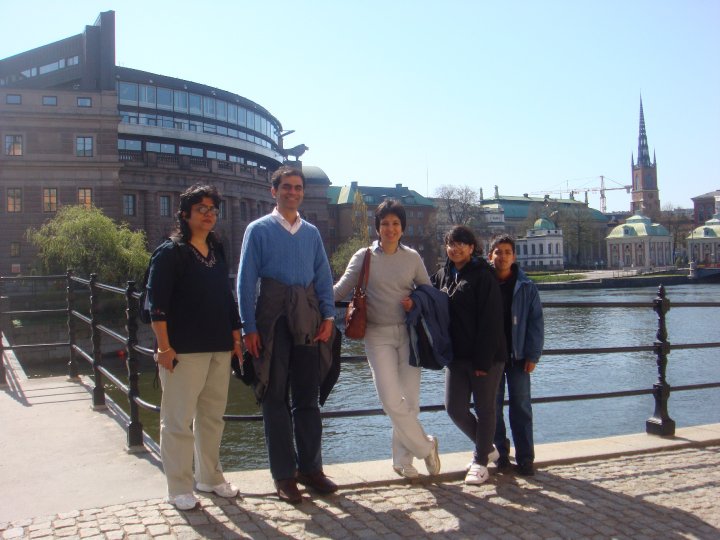
In May the following year, I found myself back in Sandviken, feeling (and behaving) like an expectant father as the design and production team put the book together. The part of the day I enjoyed most was ‘fika’, a Swedish tradition which is hard to describe – I offer the Hindi word ‘timepass’ as my best approximation. Work stops and people hang out and relax over coffee and delicious Swedish cakes.
All the intense hard work was rewarded with a long weekend in beautiful Stockholm with my brother Ravi and his family, and my friend Amita, who flew in from London. I was reading Desiree by Annemarie Selinko, a fictionalised biography of a Frenchwoman who became Queen of Sweden. This, along with the sunny weather we were lucky to have, added depth and perspective as we explored this picturesque city. Walking through Gamlastan, the historic quarter, we discovered Pippi Longstocking, Astrid Lindgren’s interesting heroine on whom, say some, Stieg Larsson’s Lisbeth Salander is modelled.
The Sandvik Asia corporate biography was launched on 8 July 2010, fifty years after the company was registered in India. It was a low-profile event, in keeping with the essentially unobtrusive nature characteristic of the Swedish. I did feel sorry, though, that the people of my city would probably never know much about this wonderful company which established base here in 1960, making it one of the first companies to bring foreign direct investment into independent India. Other Swedish companies soon followed suit, and ‘Sveanagar’ came up on the old Bombay-Pune Road, with Sandvik’s manicured lawns charming passersby.
Fifty years of growth and contribution later, the Swedish companies are a shining example of one of the oldest and most significant corporate symbiotic relationships with India, organizations that helped India to become an industrialized nation.
India had no technology and needed partners. Whom could we turn to? The British had left after a long struggle; German technology had been used for inhuman purposes during the war; The USA was too far away. Finally, it was decided to approach another quiet, inconspicuous country which just happened to have its industrial base intact. Nehru began sending trade delegations to Sweden.
Swedish companies, conservative, long-term planners, hesitated to invest in a country on the other side of the globe where tigers and snakes apparently roamed free on the streets, and the average person might hope to live just thirty-two years. So Nehru went along himself, and charmed their reservations away. In 1960, the swashbuckling Lars de Jounge arrived in Poona (as it was called then), Sandvik Asia’s first Managing Director.
My most important oral source for this book was Dr Sanjay Basu, a former IIT professor who led Sandvik Asia’s research and development efforts for decades and, now retired, continues as consultant to the company. He showed me around the factories any number of times, explaining processes and answering questions patiently.
Sadly, the company had preserved almost no documents from which we could piece together its history. Luckily there was a solution – and one which turned out to be a fulfilling adventure. We visited the parent company’s archives, preserved in the municipality at Sandviken.
I had been told, “If they want to reward you, they send you to Sweden in July. If it’s a punishment, you get to go in winter.” So when I was told to block dates in November, I knew what that meant and humbly got out my winter coat, gloves and woollen cap, and a whole lot of regular stuff that could be worn in layers for that extra warmth.
We flew to Stockholm via Munich. I was busy soaking in atmosphere from my Stieg Larsson book but couldn’t help notice the cabin crew trying to speak to my neighbour in their plastic-cheerful German. He, being Danish, would stare back, slit-eyed, and sneer disdainfully, “Sorry?” An investment bank had sent him to India and he had been mighty impressed with the progress in the nation but I think he changed his mind when I said I was on my way to Sweden and gave me a ‘You can’t be serious, go get a Life!’ look.
It had been a long time since people treated me like a rare exotic creature and I quite enjoyed it. At the archives a number of city workers stopped by to say hello. One who had just come back from a trip confided that they all knew they lived in the best country in the world – but when they went abroad no one had ever heard of them, so what was the use!
Swedish people are modest to the point of being invisible. It’s such a marked part of their personality that when they write, they hardly ever use the word “I”. When they say, “nothing but trees”, they omit mentioning that those trees, and the lakes between them, are stunningly beautiful. Nobody raves about the delicious food, so my facebook posts showing plates heaped with colourful Swedish meals surprised and intrigued my friends.
In May the following year, I found myself back in Sandviken, feeling (and behaving) like an expectant father as the design and production team put the book together. The part of the day I enjoyed most was ‘fika’, a Swedish tradition which is hard to describe – I offer the Hindi word ‘timepass’ as my best approximation. Work stops and people hang out and relax over coffee and delicious Swedish cakes.
All the intense hard work was rewarded with a long weekend in beautiful Stockholm with my brother Ravi and his family, and my friend Amita, who flew in from London. I was reading Desiree by Annemarie Selinko, a fictionalised biography of a Frenchwoman who became Queen of Sweden. This, along with the sunny weather we were lucky to have, added depth and perspective as we explored this picturesque city. Walking through Gamlastan, the historic quarter, we discovered Pippi Longstocking, Astrid Lindgren’s interesting heroine on whom, say some, Stieg Larsson’s Lisbeth Salander is modelled.Saturday, April 17, 2010
Hill Road
Heaps of cotton clothes
Fixed price, white-hot in noon sun,
Sunday, April 11, 2010
Summer
Dragon breath on skin
Sweet mangoes, bright gulmohurs,
Summer is orange.
Saturday, February 13, 2010
True confessions of a ghost writer
The awful thing about being in a profession where visibility is a key criterion of success is that regardless of the quality of your work, your friends will always think you’re a loser since you’ve never won the Booker Prize.
No one could possibly be worse affected by this unreasonable benchmark than me since I went to school with Arundhati Roy where – and the admission causes me massive shudders of mortification – she was a famous athlete and I was the one preening insufferably with the radiant glory of my wondrous and unmatched skill with words.
Worse yet is the fact that every book I’ve written to date, and also some I’m labouring over even as we speak, have been ostensibly authored by others.
Trying to feign sophistication is pointless – it’s only dismissed as sour grapes. Even my (actually rather priceless) one-liner, “If they give me cash then why do I need credit!” is no match for the sniggers of uncouth schoolmates who cruelly whisper to each other, “Ya, she’s on page 334! And you’ll need a high-rez magnifying glass if you really want to see her name!”
It’s no use my explaining that the biggest compliment to the ghost writer is when someone reaches the end of the book and only then realizes, with a start, that the voice that was speaking all this while is not that of the face on the cover but has actually been cleverly simulated by another.
It’s no use my explaining that even a book of the stature of The Autobiography of Malcolm X – listed by none other than Time Magazine as one of the ten most important non-fiction books of the Twentieth Century – was written by the high profile Alex Haley.
Yes, we ghost writers are a sadly marginalized tribe – but the truth is, our numbers are growing.
Publishing is easier today than it’s ever been before – and getting even easier. Outsourcing is now established as a mainstream alternative to getting things done, so no one need pretend any more that they actually authored their book themselves. Writing is considered a suitable – though perhaps not particularly favoured – occupation for one’s offspring. And, as the world grows more and more complex, people with fascinating stories to tell but without the skill to tell them are undoubtedly going to give more and more opportunities for highly-paid work to people like me. The prospect delights.
One day, surely, someone will coin the expression ‘self-written autobiography’.
Yet, and even after endless years spent honing the skill of presenting the most negative attribute, the most downmarket episode, the most trivial achievement in hues that colour it as enthralling – or candid, or upright, or touching, or endearing – I’m sad pressed to portray this facet of my own professional profile in a manner that might possibly invite esteem.
Whooshing out of cupboards and down chimneys in my ghostly manner, I must muse moodily – but wispily, insubstantially alone – on the significant attributes of the sensitive scribe who can listen so carefully to another as to truly comprehend all the intricacies of thought and feeling of the subject, expressed in subtle ways even if unspoken, and convey them in a suitable manner.
Most of us go through life leaving the really important things unsaid. So ingrained is this habit that few of us really know what is important in our lives, and even less know how best to say it to the ones most important to us. And yet, when towards the end of a long and fulfilling life – or phase of achievement – we take up the task of writing our story, we must find the words with which to say these things: words that will cement our bonds with loved ones without gushing, repair our strained relations with others without grovelling, and create in strangers a feeling of warmth and appreciation for our life and times. This, of course, is no ordinary skill – but it is what the ghost writer must strive to excel at.
One of the simplest directives for good-quality journalism holds up hallmark parameters to the ghost biographer equally well: “Put it before them briefly so they will read it, clearly so they will appreciate it, picturesquely so they will remember it and, above all, accurately so they will be guided by its light.” These words come from Joseph Pulitzer, the Hungarian-American publisher who is best known for posthumously establishing the Pulitzer Prizes and for being one of the originators of investigative journalism.
What Pulitzer was never recorded as having said, but we all know, is that journalists learn early to casually project an air of comfortably superior knowledge by using the right key phrases that indicate one is an insider and well versed in areas one may never have encountered till just the previous day. The ghost writer must extend this skill further and delve the depth of her subject’s life experience, making it her own. And the ghost writer must have the discipline to resist the temptation – as every good reporter must – of icing the story with her own interpretations and experience, assuming and conjuring detail or sensation where none existed in fact.
When I write on behalf of someone else, though I am primarily working as a journalist, I also project myself into a range of different roles.
I am the village letter writer who will communicate this person’s message to another.
I am the client-service executive who will investigate my client’s requirements with single-minded commitment, and work to my utmost to fulfil them as best as I can.
I am the PR machinery that will give a context to both the achievements and the failures in this person’s life and, by showcasing them in a favourable perspective, matchlessly enhance his or her reputation.
I am the confidante who will receive a stream of information and it will be my responsibility to judge which shall be published, which relegated to the wayside, and which – for some of these will be secrets never told before to a single soul – shall go with me to my grave.
To the opinionated grandson who scoffs, “Why a book about HIS life, what is so great about HIM that he should write an autobiography!” I am the Victorian school teacher who raps knuckles with the stern admonition that each human being – and in particular grandfathers of overindulged young people – has a fascinating story, and each human being has the right to tell it.
I am the productivity-oriented project manager who must structure the project into clear phases, defining milestones, moving effortlessly from one role to the other as appropriate to each changing phase, anticipating, apprehending and resolving key pressure points – while at the same time monitoring and managing every discernible parameter. And I am the commercially-savvy professional with the relaxed confidence to lay down a payment structure which protects the interests of both parties, while simultaneously nudging the project along a carefully-configured but relentless time-line.
I am the stage artiste whose own character and nature and gender and family and past – and ego – vanish completely as she seamlessly dons the persona of another.
And I am also the unglamorous writer who will never win a Booker for her work, and even if the press in her own little city beams with kind satisfaction at her every achievement, must ultimately content herself with these words that a wise woman once coined: “If they give me cash, then why do I need credit?”
first appeared as I’m not there in Open magazine on 13 Feb 2010
No one could possibly be worse affected by this unreasonable benchmark than me since I went to school with Arundhati Roy where – and the admission causes me massive shudders of mortification – she was a famous athlete and I was the one preening insufferably with the radiant glory of my wondrous and unmatched skill with words.
Worse yet is the fact that every book I’ve written to date, and also some I’m labouring over even as we speak, have been ostensibly authored by others.
Trying to feign sophistication is pointless – it’s only dismissed as sour grapes. Even my (actually rather priceless) one-liner, “If they give me cash then why do I need credit!” is no match for the sniggers of uncouth schoolmates who cruelly whisper to each other, “Ya, she’s on page 334! And you’ll need a high-rez magnifying glass if you really want to see her name!”
It’s no use my explaining that the biggest compliment to the ghost writer is when someone reaches the end of the book and only then realizes, with a start, that the voice that was speaking all this while is not that of the face on the cover but has actually been cleverly simulated by another.
It’s no use my explaining that even a book of the stature of The Autobiography of Malcolm X – listed by none other than Time Magazine as one of the ten most important non-fiction books of the Twentieth Century – was written by the high profile Alex Haley.
Yes, we ghost writers are a sadly marginalized tribe – but the truth is, our numbers are growing.
Publishing is easier today than it’s ever been before – and getting even easier. Outsourcing is now established as a mainstream alternative to getting things done, so no one need pretend any more that they actually authored their book themselves. Writing is considered a suitable – though perhaps not particularly favoured – occupation for one’s offspring. And, as the world grows more and more complex, people with fascinating stories to tell but without the skill to tell them are undoubtedly going to give more and more opportunities for highly-paid work to people like me. The prospect delights.
One day, surely, someone will coin the expression ‘self-written autobiography’.
Yet, and even after endless years spent honing the skill of presenting the most negative attribute, the most downmarket episode, the most trivial achievement in hues that colour it as enthralling – or candid, or upright, or touching, or endearing – I’m sad pressed to portray this facet of my own professional profile in a manner that might possibly invite esteem.
Whooshing out of cupboards and down chimneys in my ghostly manner, I must muse moodily – but wispily, insubstantially alone – on the significant attributes of the sensitive scribe who can listen so carefully to another as to truly comprehend all the intricacies of thought and feeling of the subject, expressed in subtle ways even if unspoken, and convey them in a suitable manner.
Most of us go through life leaving the really important things unsaid. So ingrained is this habit that few of us really know what is important in our lives, and even less know how best to say it to the ones most important to us. And yet, when towards the end of a long and fulfilling life – or phase of achievement – we take up the task of writing our story, we must find the words with which to say these things: words that will cement our bonds with loved ones without gushing, repair our strained relations with others without grovelling, and create in strangers a feeling of warmth and appreciation for our life and times. This, of course, is no ordinary skill – but it is what the ghost writer must strive to excel at.
One of the simplest directives for good-quality journalism holds up hallmark parameters to the ghost biographer equally well: “Put it before them briefly so they will read it, clearly so they will appreciate it, picturesquely so they will remember it and, above all, accurately so they will be guided by its light.” These words come from Joseph Pulitzer, the Hungarian-American publisher who is best known for posthumously establishing the Pulitzer Prizes and for being one of the originators of investigative journalism.
What Pulitzer was never recorded as having said, but we all know, is that journalists learn early to casually project an air of comfortably superior knowledge by using the right key phrases that indicate one is an insider and well versed in areas one may never have encountered till just the previous day. The ghost writer must extend this skill further and delve the depth of her subject’s life experience, making it her own. And the ghost writer must have the discipline to resist the temptation – as every good reporter must – of icing the story with her own interpretations and experience, assuming and conjuring detail or sensation where none existed in fact.
When I write on behalf of someone else, though I am primarily working as a journalist, I also project myself into a range of different roles.
I am the village letter writer who will communicate this person’s message to another.
I am the client-service executive who will investigate my client’s requirements with single-minded commitment, and work to my utmost to fulfil them as best as I can.
I am the PR machinery that will give a context to both the achievements and the failures in this person’s life and, by showcasing them in a favourable perspective, matchlessly enhance his or her reputation.
I am the confidante who will receive a stream of information and it will be my responsibility to judge which shall be published, which relegated to the wayside, and which – for some of these will be secrets never told before to a single soul – shall go with me to my grave.
To the opinionated grandson who scoffs, “Why a book about HIS life, what is so great about HIM that he should write an autobiography!” I am the Victorian school teacher who raps knuckles with the stern admonition that each human being – and in particular grandfathers of overindulged young people – has a fascinating story, and each human being has the right to tell it.
I am the productivity-oriented project manager who must structure the project into clear phases, defining milestones, moving effortlessly from one role to the other as appropriate to each changing phase, anticipating, apprehending and resolving key pressure points – while at the same time monitoring and managing every discernible parameter. And I am the commercially-savvy professional with the relaxed confidence to lay down a payment structure which protects the interests of both parties, while simultaneously nudging the project along a carefully-configured but relentless time-line.
I am the stage artiste whose own character and nature and gender and family and past – and ego – vanish completely as she seamlessly dons the persona of another.
And I am also the unglamorous writer who will never win a Booker for her work, and even if the press in her own little city beams with kind satisfaction at her every achievement, must ultimately content herself with these words that a wise woman once coined: “If they give me cash, then why do I need credit?”
first appeared as I’m not there in Open magazine on 13 Feb 2010
Subscribe to:
Posts (Atom)
