Wednesday, June 10, 2020

The Awful Truth About Pocha-Pani

Lockdown, being unable to leave the house or to have anyone visit, meant that housework had to be done by the inhabitants. Three of us shared the duties and it was a great relief that it proceeded with no bickering and high standards of not just F&B but housekeeping too. In the early days I even wrote an appreciative poem which if you like you can read here.
It reminded me of an earlier phase - more than twenty years ago, and a column I wrote for Times of India, Pune:
As I write this, I can see a broom standing in a corner, gazing reproachfully at me, and I am pitting all my wits towards repulsing it. What nerve – the repulsive creature! Brooms, I grew up with the firm knowledge, had only one sensible function: to be ridden on.
And I’ve ridden a great many in my time, and even now, in my days of peace and plenty, sneak out on occasion at the dead of night, clamber onto my trusty long-handled steed, and take the long flight past the full moon. In metaphor, that is, dear reader – only in metaphor.
But this one here, standing in the corner, continuing to glower and distract me from my elevated mission, has clearly forgotten its humble station in life. The cheek! Under the influence of its sulky stare, I have no recourse but to look around and painfully acknowledge the presence of assorted cobwebs and filthy little grey curlicues in the corners, the curlicues being also known, by my vocabulary-impoverished and totally obnoxious offspring, as “yucky black-black things” with the recommended usage: “Mumm-aa, why there are so many yucky black-black things in our house? In Zara’s house there are no yucky black-black things only.”
Not only did I come back from my holiday in serious need of a rest, not only did I pay for it before I left in extravagant wads of time, energy and units of currency, but I’ve come back to find that I still have to pay more, and further do all the unpacking, cleaning up and sorting out on my own because the housemaids, foolish wenches, have unanimously departed.
Once upon a time, long, long ago, Ma Sadhana came to my house to interview me for an article for the Osho Times on women and creativity. I was up to my knees in pocha-pani then too, having been devoid of the blessed and soothing presence of any Household Help for several months and I held forth at length on what a wonderful opportunity I was having to learn how to clean the toilets, make chappatis and so on. An opportunity I had never had in the past (and, I hoped, but didn’t add, I would never have in the future) and was therefore making the most of. And this, I waxed eloquent before Sadhana, was a situation which had scope for such tremendous creativity! What I really, really enjoyed, I went on, was being creative in private! Creativity, I ended with a flourish, was not something that needed applause to be classified as creativity! (I meant it, I swear I did.) And when the article appeared, alongside a photograph of myself so glamorous that none of my numerous friends, relations or acquaintances could recognize who it was, I gloated, congratulated myself for weeks without end, and sent copies to the entire lot of them. Most, unfortunately, were grossly under-equipped to tackle Sadhana’s exquisite Hindi prose but I can tell you they were, one and all, awed and impressed by the whole affair.
Sensing that I was on to a good thing, I wrote an article about how virtuous I was and how much I loved housework, and how I just couldn’t understand why most women made such a big fuss about it. It was such a brilliant and well-written article, with such a clever and original theme, and I sent it off to a friend who happened to be editor of a popular women’s magazine at the time. I’ve never been able to understand why she indignantly sent it right back, declaring it unfit for publication.
But meanwhile, talking about pocha-pani, here I have yet another large and smelly bucket filled with the stuff and I’m looking around wondering, wondering and wondering, what on earth am I going to do with it?
Do I flush the exotic cocktail down the toilet? Because I’m not much looking forward to cleaning that indispensable commodity (commode-ditty, get it? – hah!) either. Do I throw it in the garden and risk murdering my beloved husband’s beloved plants with the fenyle and other vile ingredients it contains? Or shall I pour the delectable gravy (floating richly with strands of lustrous – luxuriant, even, if modesty will permit me – black, coconut-oil lavished hair) in the sink, and airily leave the choking which is bound to result, to be dealt with on another day?
All the long years I have employed other humans to clean my home on my behalf, what on earth they did with the pocha-pani has remained to me one of the great mysteries of life.
I go through phases of keenly scouring the Handy Hints sections of newspapers and magazine for likely answers, but it is a topic coldly neglected by one and all. I can’t imagine why.

A little history about where and when this first appeared

While crediting Times of India, Pune, for having published the above article on 30 August 1997, I need to clarify that in those days TOI did not have a full-fledged Pune edition. The article was actually published in a supplement called Pune Times, which accompanied the Times of India, Mumbai, in those days. When I moved to Pune in 1993, the good people of Pune were still making doing with the TOI’s Mumbai edition. In fact, TOI was new in Pune and the most popular paper then was Maharashtra Herald, with Indian Express selected by readers who wanted to feel more connected nationally. When my editor at TOI Mumbai, Darryl D’Monte, heard that it was the Express that was being read in my home, he gave me such a reproachful look that we promptly shifted to the TOI. Over the years, a very large population of Pune did so too and of course Darryl, in his editorial capacity was responsible for that too.
But, back in 1993, it was very flattering for me to have the managers of TOI, Pune, T. Ninan and Winston Machado, periodically phone to tell me that they were planning a TOI Pune edition and wanted me on board as editor. 
‘Phone’ reminds me of the six-digit numbers we had back then; we'd migrate from 671261 to 26851261 over the years as the exchange modernized. The number remains even today, but BSNL lines are so bad that it is seldom used.
Anyway: Ninan and Machado and whoever else was making decisions in those days had no idea that I was not the right person for this job. Ascent, which I had launched for the TOI in Bombay in 1990, was a huge success IN SPITE of rather than because of me. They may not have known this, but I certainly did, and politely declined all their seductive offers.
Eventually, Sherna Gandhy moved from Bombay and launched the Pune edition of TOI and ran it for a few years. It began as Pune Times, a supplement to the Mumbai paper. After the main newspaper began in Pune, Pune Times gradually evolved into a paid-news platform for individuals and organization seeking publicity, and I’m afraid I’d rather just say that this pocha-pani saga, one of my favourites ever, was written for Times of India, Pune.

Thursday, January 16, 2020

Village Naya (Pingala)

This is Rukshana, whose family belongs to a tribe of wandering minstrels.
Through the generations, they painted their stories and sang them aloud, showing their lovely scrolls to the audiences that gathered to look and listen as they walked from village to village, stopping to perform every now and again. As time passed, priorities changed. Television must have reduced their audiences significantly. The government of West Bengal settled them in villages, and the one we visited yesterday is Naya (Pingala), a 3-hour drive from Kolkata.
Rukshana showed us her family home, decorated with scrolls of her great-grandfather, paintings made by family members, and books and artefacts collected by her father Bahadur. She explained how they extracted colour from ordinary plants to make their paintings, and the techniques they use. 
You can see Bahadur in the photo on the right, signing an exquisite work of the Sunderbans he had painted some time ago. This seems to be different from his earlier work, many of which are done in the Kalighat style and tell droll stories (in the photo above with Rukshana, the painting in front has a man standing behind a seated woman, helping her with her make-up and fixing a hairpin). These are not particularly connected to the Patachitra tradition which traditionally documents both stories of Hindu mythology as well as striking contemporary events. (A village wall  depicts the recent Pulwama incident, there's a photo later in this post).
This was our second visit to Village Naya. We had come two years ago, visiting visited homes and heard traditional songs. This one is the story of Radha-Krishna and you can see the children - even the baby who is not yet able to stand on her own - joining in the chorus. 
One of the high points of the fascinating day was a delicious meal
prepared by Rukshana’s mother, which we enjoyed very much.
We were tourists - but also sincere students, and had decided to return for another day that combined elements of a visit to a museum of rarities, an art workshop and an anthropology field-trip. 
In 2017, it was Rukshana’s brother Rajesh who had shown us around. I asked Rukshana how come they had names which indicated that they followed different religions, and she explained that their tribe were Muslims. However, they painted Hindu stories and often performed for Hindu families. When those families expressed their discomfort that they were from another religion, they gave themselves Hindu names too. Nowadays, she explained, nobody bothered having two names, as Hindus and Muslims were just the same and she had only ever had the one name, Rukshana.


Sunday, January 5, 2020

The Case of the Aggarwal Cross

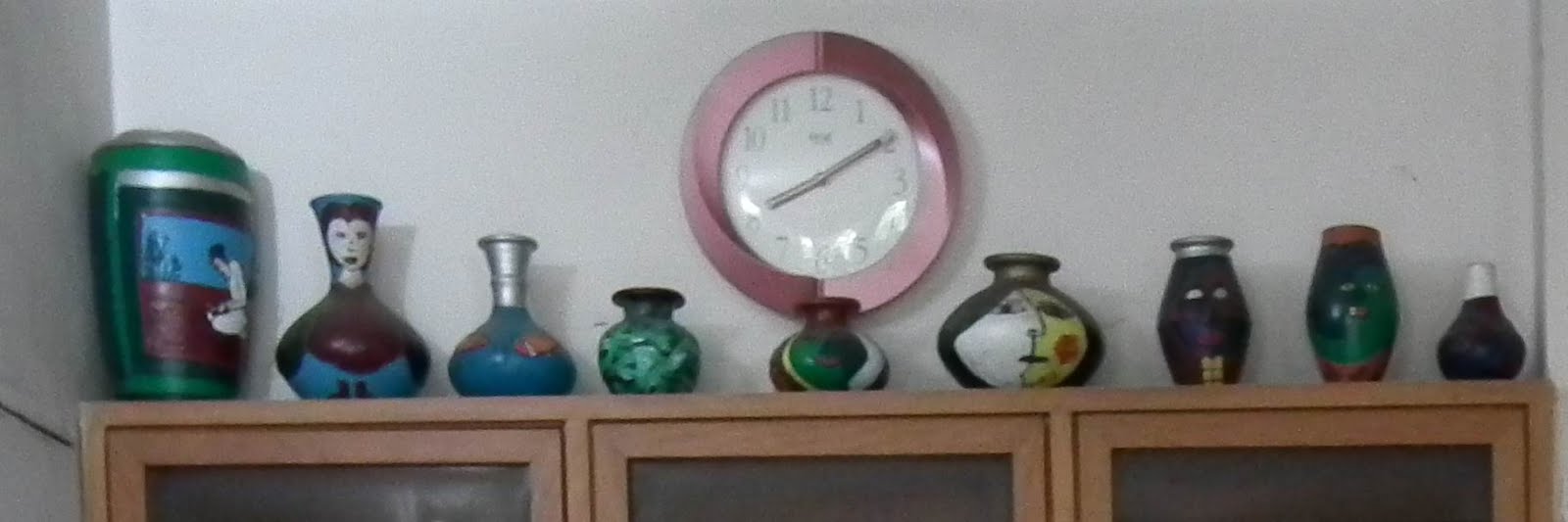
One day, the pots fell down.
I was away, in another country, so far from home that if I tried to get any further I would be on the way back. To inform me about the pots, I was sent an evocative photograph of the broken pots in a dustbin and the poetic caption: “Matki phooti”.
‘Matki phooti’ is a philosophical koan derived from a song of the 15th century mystic poet Kabir, which translates roughly to:

It’s such a good thing that my pot broke. 
Now I don’t have to fill water any more.


About the pots: I had painted a range for a charity bazaar many years – a decade or more – previously and these were the ones I’d kept for myself. If I had ever taken Marie Kondo on an inspection around my house, it would have been a long and busy inspection, 
but the pots would have been retained. Now they were gone.
Back at home, I found that the garbage collection team had left quite a few of the shards in a corner of the garden.The idea of making a collage emerged from a lovely artefact I had seen in a corner of the Sacred Heart Cathedral in the old town of Panama City, these days a trendy area with night life and boutiques and all. I never asked about the significance of the pottery shards arranged thus when I saw it, but was so charmed that, looking at my photos of the trip, decided to give it a shot. So on a day when I had the house to myself, I gathered up the broken bits and pasted them onto some tiles, stoically employing a shoe to flatten them so that they would stick nicely.
Once the Aggarwal Cross was ready, I started preparing to proudly display it in a prominent place outside the house. 
However, the precocious author of the ‘matki phooti’ response now had another penetrating observation about these goings on: “It’s a good thing nani isn’t ever going to see this!” 
Everyone turned various shades of pale. My mother, whose family had been displaced from their homeland – summarily exiled from their home province – by the events following the Partition of India in 1947 when she was a child, had always been a proud Hindu very sensitive to the slightest hint of religious conversion. What would she have felt about having such a large cross, no matter how pretty, outside our home?
In the end, my gorgeous cross was relegated to a place where nobody is ever going to see it. I myself hadn’t gone to worship at it for several months and now, looking at its bits and pieces am suffused with a sense of satisfaction. Partly for having turned from regret to creativity; partly for having produced a work of art; partly for the symbolic juxtaposition of broken bits, such as placing a worshipper right in its heart. 

Friday, November 29, 2019

Woody Allen does Mumbai

Apparently today is Woody Allen's birthday. That reminded me of a column I used to write for Sunday Mid-day, pretending to be someone else, and here's what happened when Woody Allen did Mumbai. Since I wrote it really long ago when I was someone else, I suppose it's ok to say that when I read it after all these years I thought it was quite amusing.

Woody stalks Annie in Mumbai

Annie Tharakan limped because her shoes were too tight. “Didn’t you try them on before you bought them,” her mother barked. The truth was that Annie had not felt comfortable in the shoes but she could never bring herself to say no to a salesperson. “I want to be liked,” she admitted to Sushma-madam, the nerdy Maths teacher. “Once I gave all my pocket money away to someone who said she was collecting for the Deaf and Dumb Association. She sprinted away as soon as I put the money in a tin piggy bank which she held out to me, and I’ve never seen her again at the Solar System mall.” Annie and her school-mates did spend a lot of time at the Solar System mall. They liked it because the escalators had shiny handrails and there were large signs that said SALE 50% discount on selected items, conditions apply. But also because it was air-conditioned and the toilets had a warm-air hand dryer which occasionally worked. Sushma-madam was outwardly sympathetic but she would later mock Annie in the teachers’ common room. Annie’s mother, who taught Geography, happened to be there. She told the others about certain tribes in Borneo that do not have a word for “no” in their language and consequently turn down requests by nodding their heads and saying, “I’ll get back to you.” She too appeared warm and understanding and inviting of confidences, but later hit Annie on the head with the blunt handle of her imported rubber spatula all the same. “Why did you buy them if they’re too small?” she asked Annie, unaware that she was articulating a quintessential human paradox. The day Annie bought the shoes, she had actually gone looking for bras. A nice-looking but slim sales girl with a name tag that said Cynthia came up and said “Have a nice day”. Annie was desperate but felt shy to ask for help because there was a man watching her and she naturally didn’t want him to hear what she said when she confessed her bra size to Cynthia. For some reason, Solar System had put this pimple-faced youth in charge of Nighties. Women would approach the counter but turn around quickly once they saw him. Naturally, nobody ever bought any nighties. He was quite a pleasant-looking fellow actually, as he leaned comfortably on his counter, resting his chin on his arm, and watched while Annie crept round trying to pick up bra boxes and check the size and design without him actually seeing what was written on them. Finally she gave up and wandered towards some loud sounds near the entrance. It was the finals of a song and dance competition. Annie watched with envy as Pravina who sat next to her in class swayed and bent to the sounds with simple abandon. Even Rishi, the boy whose father ran the kirana shop just outside Annie’s building was swinging beautifully. No one could imagine that the Rishi who helped at the shop on weekends and made home deliveries on his bicycle outside school hours could have reached the semi-finals of this national show with footfalls as stylish as these! Annie sighed. She felt sad and depressed. Slowly, she walked towards the food and grocery section, and inched to the chocolate counter stealthily checking from the corner of her eyes that no one was watching. Near the dog food counter, a boy and girl called Rinku and Pinky were sailing a ball at each other, skipping around, and singing a very silly song. Annie did not even have a dog. She did not know the meaning of the expression GIMROI. But she did have enough money to buy some chocolates. There was no Zippy-mate raisin-enriched fun-bar, the chocolate that gives you more raisins, more chocolate, more iron content, more energy, more calories, more everything per cubic metre than any other chocolate. Annie did try asking two sales girls where she could find some, but they were very engrossed in whispering secrets to each other and when they detached, they would only look at the other shoppers and tell them admiringly, “Good morning, madam!” and “How can I help you, sir!” with so much charm, sincerity and enthusiasm that Annie just did not feel like getting in the way and she bought Cheepy-mate instead since it was marked down to Rs. 5 from Rs. 13.50 and also 15 for the price of 3. Their lovely green-striped aprons reminded Annie of Cynthia from the Ladies’ Underwear Department and filled with a new resolve, she went back upstairs, determined to get what she had come for. Cynthia was kind and when she understood the problem, asked the pimple-faced youth (Annie saw from his name-tag that his name was Viren) if he’d mind going on his lunch break now. He argued for a while, then before he moved off gave Annie a deeply reproachful look which Annie knew would haunt her forever. Later, she stood in line at the till with the 3 bra boxes concealed safely at the bottom of basket filled with dog food and Zippy-mate and the shoes which were too tight. But when her turn came, she was horrified to discover that there was no barcode sticker on them and the till assistant had to call out loudly to the supervisor, describing the product in great detail so it was heard by not only everyone in the store but also Viren, the pimple-faced youth, who happened to be passing by at that moment and he turned around and gave Annie a triumphant sneer. Annie was sad but it was a lesson she would never forget as long as she lived and a few years later when she became sought after as a witty dinner companion she would hold long discourses on the subject and repeat often “Location,” – and here she would briefly before driving home the punch line – “Location” (she would repeat for effect) “is everything.” 
First appeared in Sunday Mid-day on 26 March 2006

Tuesday, July 16, 2019

In case you haven't noticed my ar...


I met Mitalee Joshi for the first time at Pune Biennale in January 2017 and was not just entranced by the installation she was setting up, but inspired too. Since then I have been following Studio 7’s work, and over the last weekend was fortunate to be able to attend a workshop with them. I’ve always wanted to learn mosaic-making and was thrilled to have this opportunity. The workshop was well conducted in a lovely environment with all material provided – and chai and thoughtful snacky meals served too. With the notes circulated after the workshop, I found it an excellent overview and am happy to have taken home the basics of the craft and can’t wait to start using what I learnt. 

The theme of this mosaic workshop was ‘Balinese mask’, and we were provided with boards cut into the shape of a Balinese mask on which to fill in our mosaics. However, I could not resist using a theme not necessarily native to Bali, something that continuously informs my work: “who I really am and who you see me as” or “the real me” or “in case you haven’t noticed my artistic temperament, take a closer look, please”. I won’t say I’m happy with my work, which looks like a school craft project, but I’m so very happy to have learnt the basics of mosaic.


Sunday, January 20, 2019

Mandai 26 Jan 2019 – Between spaces

There are spaces that intersperse pieces of music – and those spaces are silence, so essential for a musical piece to breathe and reverberate.

Then there are spaces that intersperse periods of music media – and those spaces are overlaid with melancholic uncertainty; the regretful passing of an era. I chose one of those spaces to work with for this edition of Art Mandai 2019, dismembering audio cassettes and using their elements to create a fun nostalgia RIP series. Along with the cassette elements, discarded fabric and related items have been used to create mini statements about our life and times.
For eons, a musical performance could be heard only once. From the cave people singing in their mud pools to the classical performers of yore, the moment could never be recaptured. Even in the recent past, people would walk all day to reach the site where Bhimsen Joshi was expected to sing ragas and abhangas all night long! Today, music surrounds us, and often – as in the case of advertising jingles or car reverse horns – we are hardly even aware of it. During this magical journey, a few small spaces stand out. The era of the audio cassette is a significant one, being the first time that recorded music was becoming available to everyone; the first time that people could even make their own recordings. The generation which lived through this period experienced it as one of intense, disbelieving joy and gratitude for the music. My collection for Art Mandai 2019 is a tribute to those who clung on to their precious audio cassettes, a means to commemorate precious belongings for which their homes no longer have the space.

The Velvet Underground and Warhol’s banana

The Velvet Underground’s 1967 debut album had a controversial cover by Andy Warhol: the image of a banana with a “Peel Slowly And See” instruction. The banana peel was a sticker that revealed a flesh-coloured fruit beneath. This art work presents a pale imitation of Andy Warhol’s banana, embellished with crotchet flowers created from audio cassette tape.
This annual show will be held, as always, at Pune's iconic Mahatma Phule Mandai from 8.30am to 2.30pm on 26 January 2019.
Do visit! 

Sunday, September 23, 2018

A long-ago place and time where women were treated, unexpectedly, as people

A few days ago, Scroll.in carried something I wrote about women in pre-Partition Sindh, Freedom fighters and ticket checkers: The trail-blazing women of pre-Partition Sindh.
In 1936, Kishni Lalvani  (the second lady from the right), 
was one of a group of young ladies on a tour of Europe, 
chaperoned by a respectable Scottish lady who  lived 
in Hyderabad. Quite a stir they created, in their elegant and 
fashionable saris, from Norway to Spain and beyond! 
They visited cultural sites and interacted with cultural 
groups, and people were charmed by their poise and
flawless English. This clipping appeared on 20 June, 1936.
Captioned ‘Hindu students in Barcelona’, it went on to say,
“The group of Hindus students that is taking a study trip
through Spain has arrived in our city, visiting our museums,
our monuments and our teaching officers”. The photograph, 
by Puig Farran, was taken at the Patio de los Naranjos de la 
Generalidad. Image courtesy Kishni's daughter, Bina Thadani. 
I wrote it several weeks ago, in response to another scroll article, about Om Mandli, a socio-religious organization which originated in Sindh in 1935. 
While discussing the article with some friends, one sentence struck us particularly: 
What is remarkable is that, in pre-Partition Hyderabad, where patriarchal norms and misogyny was at its heights, some of its courageous women powerfully resisted the yoke of men and subjugation. 
While there were certainly patriarchal norms and misogyny, and these continue to pervade the world, as far as we knew they were not at their heights in pre-Partition Hyderabad. I have interviewed quite a few elderly Sindhis and from what they told me, there were Hindu Sindhi women who owned property, made financial decisions and had certain privileges of empowerment even when they were not contributing to the family economically.
Gomibai Javhermal Shahaney relaxing at
home with her newspaper. Karachi c1940
Courtesy Sunita Shahaney
I sat down and wrote some of the stories. Eventually the piece was held back for so long that it didn’t make sense to link it to the Brahmakumaris story and though I worked on rewriting it, I did feel that the rejoinder version was much more effective . So I'm putting down the full version here, with more examples, photographs and details.
One charming snippet of memory from the 1930s has Ruki (daughter of a zamindar, Lokumal Malkani, and wife of Dr Naraindas Mirchandani) driving their children home to Old Clifton from the clinic, singing bhajans to lull them into a pleasant mood. Ruki loved to drive, as did quite a few of her generation; another was Jassie Kundanmal Ramchandani – Jessie to her friends – who drove her own car in Sindh even before she got married. 
Jamna Pahlaj Gidwani
(nee Jamna Sahibsing Shahani)
had a driving license in 1928.
Courtesy Nelum Gidwani
Jamna, daughter of the illustrious educationist Sahibsing C Shahani, had a license in 1928 and drove for years until – as her son Nelum Gidwani wryly observes – she ran over a chicken somewhere in France and decided she’d had enough of it. When Indroo Sitlani learnt to drive in Bombay after Partition, it was one of his sisters who taught him. 
While these were clearly women from well-off families, there were working women too. During the Second World War, sea routes closed and many Sindhworkis, men with trading outposts in ports around the world, were isolated from their families in Sindh. Hassaram Ramchandani and his sons ran stores in Cairo and Basra and could not return. It was his daughters Sati and Ishwari who managed Lucky Store, a front room of their home near Tikunda Park at Gadi Khato in Karachi. Sati was a Balkanjibari (Sindhi kindergarten) teacher and took turns with Ishwari who, as her son Ashok Shahani told me,  worked in the Locust Control office on Bunder Road until Partition. There were no toilets, and Ishwari wrote to Indira Gandhi, requesting support in getting toilets built. And that, says Ashok, a Supreme Court lawyer, was how the rolling plan of 1950 came to budget one toilet in each Central Government office.
Quite a few also worked for the Railways in Sindh, checking passengers’ tickets. For a woman to do this doesn’t just mean that she is outgoing and confident. It doesn’t just mean that her family supports – to an extent – her individuality and ambitions. It also means that the men of Sindh could accept authority from a woman. Sundri and her sister Popati, ticket checkers on the Hyderabad-Kotri commuter line, were beauties. There was a line of suitors. But Sundri fell in love with Gobindram Shahani and that was that. Popati married Mohan Mansukhani. After Partition they were able to continue supporting their families with jobs in the Railways. In an era of child marriage across India, both married in their late twenties. This was not at all uncommon in Sindh.
Many have told me that their parents ‘did love marriage’ in Sindh before Partition. Many have spoken of sisters who never married because they were overweight, dark-complexioned or disabled – negative attributes in the marriage market as they continue to be – because their families were unwilling to compromise them with potential grooms who were offered in marriage because they had less-than-appropriate attributes of their own. 
Mira Advani: a First Class
double graduate with MA
and MSc in pure and
applied Mathematics from
DJ Sind College at age
19. Karachi c1943
Part of the status of Sindhi women is due to the campaign for women’s education, introduced by Navalrai Advani, son of Shoukiram Advani, Mukhi of Hyderabad, who was so deeply influenced by the Brahmo Samaj that he made the one-week train journey to faraway Calcutta to find out more. The first school for girls in the Hyderabad Municipality c1885 was personally funded by him and Sahajrai Chandomal Advani. The progressive families of Sindh took women’s education very seriously. The list of the South Asians who became barristers at three Inns of Court in London before Independence, derived from research conducted by Mitra Sharafi at University of Wisconsin Law School, carries the names of two Sindhi women: Saraswati Dayaram Mirchandani who was called to the Bar in 1937 and Shakuntala Rochiram Hingorani in 1947. 
Dr Valiram Lakhani
Courtesy Dr Naresh Shivdasani
There were also a large number of ‘lady doctors’ (as they were called then) coming out of Sindh, a boon in a time when, despite high mortality in pregnancy and childbirth, families were reluctant to have their women administered by males. One of the earliest was Devi Lakhani, LMCG Edinburgh. Her father was Dr Valiram Lakhani of Hyderabad; all his daughters were well educated and he sent Devi off to study overseas in the 1920s.
Dr Hari Mirchandani, carrying Meena (now Meena Mani),
her brother's daughter whom she had delivered
two days previously, Delhi 1950.
Dozens of Sindhi parents sent their daughters to study medicine at Lady Hardinge College, Delhi, and live in the hostel there in the 1930s and 40s. Dr Hari Mirchandani practiced in Hyderabad and Mirpurkhas, and after Partition started a practice in Delhi’s Karol Bagh, then rented a house and, saving every paisa she could, built a one-storey house for her clinic, eventually building quarters above with a maternity home on the ground floor. 
Some time around 2009, in pursuit of a location for the
Sukkur branch of SIUT (Sindh Institute of Urology 
and Transplantation), Pakistani philanthropist Dr Abid Rizvi 
and his team came across the Chablani Maternity Home 
in a decrepit state. Dr Rizvi worked with the Sindh 
government to transform it into a modern facility 
by 2012 and they named it SIUT Chablani Medical Center.
They spent several months trying to contact Lila’s relatives
in India to get a portrait of hers to display in a prominent place.
Lila’s niece, Sujata Tolani, arranged for family photographs of
Lila to be scanned and composed to show her at different times
in her life, and sent this photograph to SIUT, Sukkur.
Lila Chablani, who ran a nursing home in Sukkur, stayed on after Partition and took care of her parents as they aged.
Quite a few other women too rose to be prominent citizens and lived independent professional lives in urban and rural Sindh. Most continued to practice in towns and cities across India after Partition; a walk through Bombay streets even today reveals nameboards and memories. In the 1950s and  60s, many went to live and work in the UK and US. Two of Dr Naraindas’s daughters, Mohini (later Gidwani) and Leila (later Advani) studied at Lady Hardinge too and both did their higher medical education in the UK. Before she left for the UK, Leila worked with Partition refuges in the children’s hospital at the Kurukshetra refugee camp in Delhi. 
In the early 1950s, the American Medical Association requested the Indian Medical Association to send a few young doctors as interns in their hospitals. Dr Popati, who had graduated from Lady Hardinge College, was in the first batch interviewed. Her father, Diwan Hashmatrai Mansukhani, gave permission for his young daughter, and subsequently two more daughters, to go to Chicago. It was a time when USA was considered excessively distant and Chicago was known for its high rate of crime. Diwan Hashmatrai faced criticism but his courageous act turned out to be a pioneering one because soon, other Sindhi families who were also victims of Partition and were worried about their children’s higher education realized that in USA it was possible to support yourself by working as you studied. 
Dr Lila Pahlajsingh Advani studied at Lady Hardinge College in the 1940s and after Partition built up her practice with a clinic in Colaba. In 1964 she moved to New York and continued working there as a doctor and living on her own for forty years. Lila was a keen photographer, she had a darkroom and developed her photographs herself. In Bombay, she spent time with her nieces and nephews, helping them with their studies and taking them on drives to Juhu where they made sandcastles on the beach and collected shells to make dolls and other curios. Lila never wasted a moment. She kept her knitting in her clinic so that she would have something to do between patients and was well known for the knitted, crotchet and tatting garments and table linen she made.
Kamla Hiranand
Courtesy Jyoti Punwani
Sindhi women didn’t just work, they also fought in the Indian freedom movement. The frail Devi Kripalani (Kamla Hiranand after marriage) led protests and challenged her jailers. During Jethanand Shahani’s six months in jail for his activities in the freedom movement, his wife Kala’s parents and his parents urged her to come and stay with them but she lived alone in her own home and continued to manage their secret press. 
One of the most prominent Sindhi woman freedom fighters, and the best known Sindhi woman social worker of her generation, was Jethi Sipahimalani. From a prominent and well-off family of Sindh, she completed four academic years at DJ Sind College as a casual student in English, a special facility created by Principal SC Shahani (father of Jamna Gidwani mentioned above) for girls who had not passed the matriculation examination to study further. In 1929, she was principal of Daya Ashram but quit the following year to join the Indian National Congress, participating in pickets and protests. Jethibai held prominent civic posts and in 1938 served as Deputy Speaker of the Sindh Assembly. After Partition, she worked for the displaced people from Sindh and her most enduring legacy is the Navjivan Society housing colonies she built in Bombay.
Mohini and Sujan Bhawanani
Calcutta 1972
When I interviewed Mohini Bhawnani in Kolkata in July 2016, she was 84. Mohini was born into an affluent family, but her father died when she was four and her brother two, a time of great struggle. After Partition, they moved to Kolkata and when their mother died, Mohini supported herself and her brother first by selling her father’s gold medal and then by working as a school teacher while she continued her studies. She gave a competitive examination to enrol as an engineer in the telephone department and was placed fourth among four hundred candidates. In 1957 Mohini married into a wealthy family but continued working and as the years passed, she was promoted to higher positions. One of Mohini’s memories was of her journey across the new border after Partition. Her mother had stayed on in Karachi to try and sell their home, and put her 15-year-old daughter on the SS Barpetta to Bombay in the care of an acquaintance, an Idnani. The first evening on the ship, he  got drunk and began making advances. Mohini escaped and took protection with the ship’s captain. Mohini was keen to share this story, more than a year before #MeToo went viral. 
As for the Om Mandli, I do believe that one of its aims was an early version of women’s empowerment. I have tried to uncover awful truths but only found it well-meaning (if slightly peculiar, in a cultish way). This was reinforced when I visited the Brahmakumari headquarters in Mount Abu last year. Whether ghastly relics lie around the corner remains to be seen.
Many of the followers of Dada Lekhraj were women of the Sindhworki community, and as Dr Devendra Kodwani, Dean at Open University, UK reminded me, the widespread travels of the men were likely to have impacted their outlook on life and views on the role of women. These were women certainly oppressed by dowry and family elders – Monica Bhojwani who was born in a prisoner of war camp in France in 1940, told me about a neighbour whose mother-in-law gave her no privacy even in her bedroom; no freedom to even express physical affection for her children. Still, long years of running their homes and families while their menfolk worked in other countries, certainly nurtured capability and decision-making ability. 
One of the things retired academic Madhuri Sheth told me is that when she was little, her father, Udharam Gurnani, had friends who were women from Sindhworki families. I found it interesting, and an indicator of a progressive society, that men and women could be friends in the 1940s, simply enjoying each other’s company and conversation.